What is AI screenplay analysis?
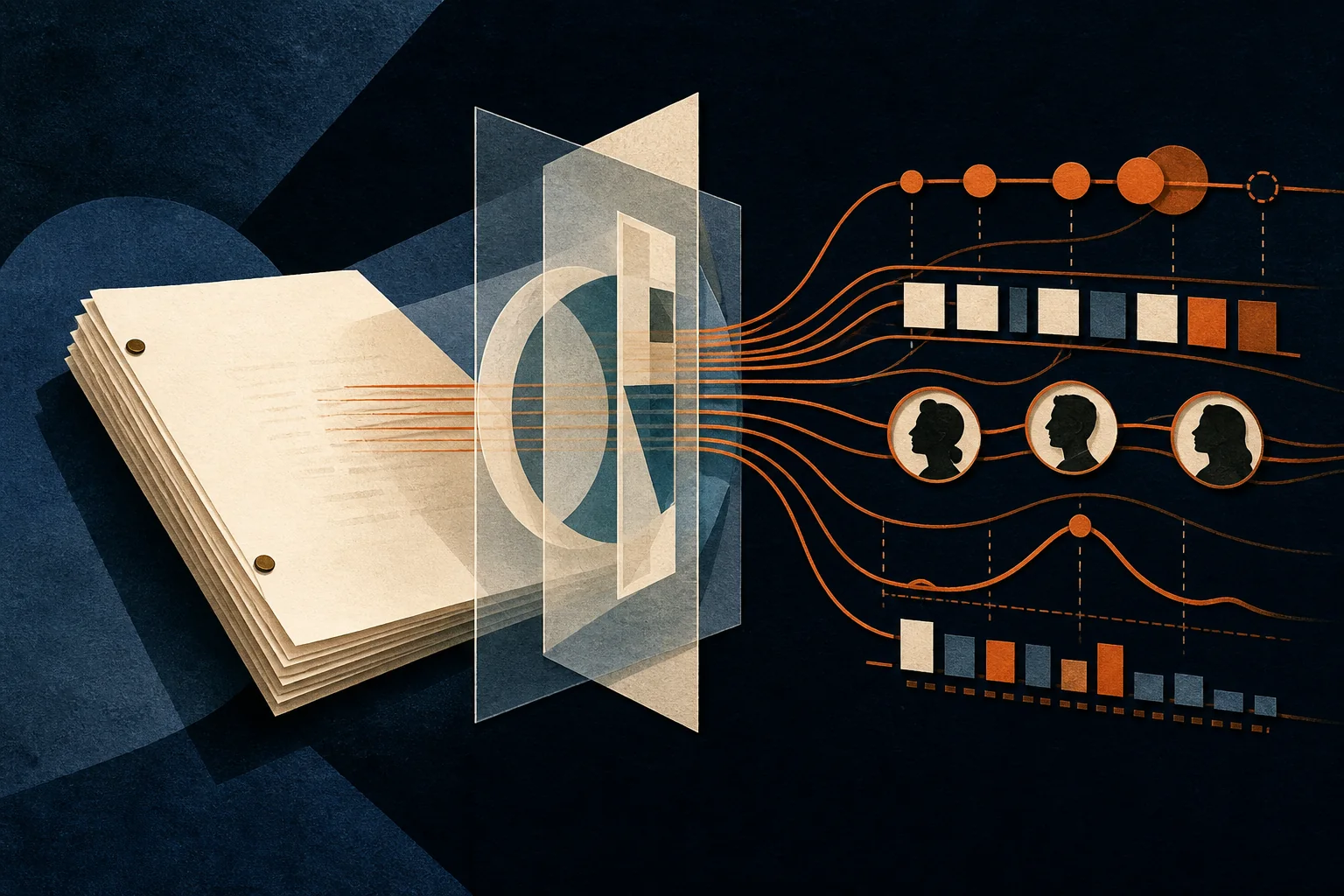
AI screenplay analysis is a structured review of a script or scene that looks for evidence about character objectives, conflict, structure, dialogue, pace and clarity. A useful report points to patterns on the page and turns a broad reaction such as “the middle feels slow” into questions a writer can test.
That makes AI script analysis a diagnostic second read, not an objective judgement of whether a screenplay is good. It cannot know the unwritten film in your head, predict every audience or replace the taste and accountability of a skilled human reader. The writer still decides what the story means and which notes belong in the next draft.
ForgePad’s scene reports sit beside the screenplay and examine purpose, conflict, tension, dialogue and possible rewrite moves. They are designed to support a decision while the scene is still open, rather than produce a detached score that ends the conversation.
What an AI screenplay analysis report looks like
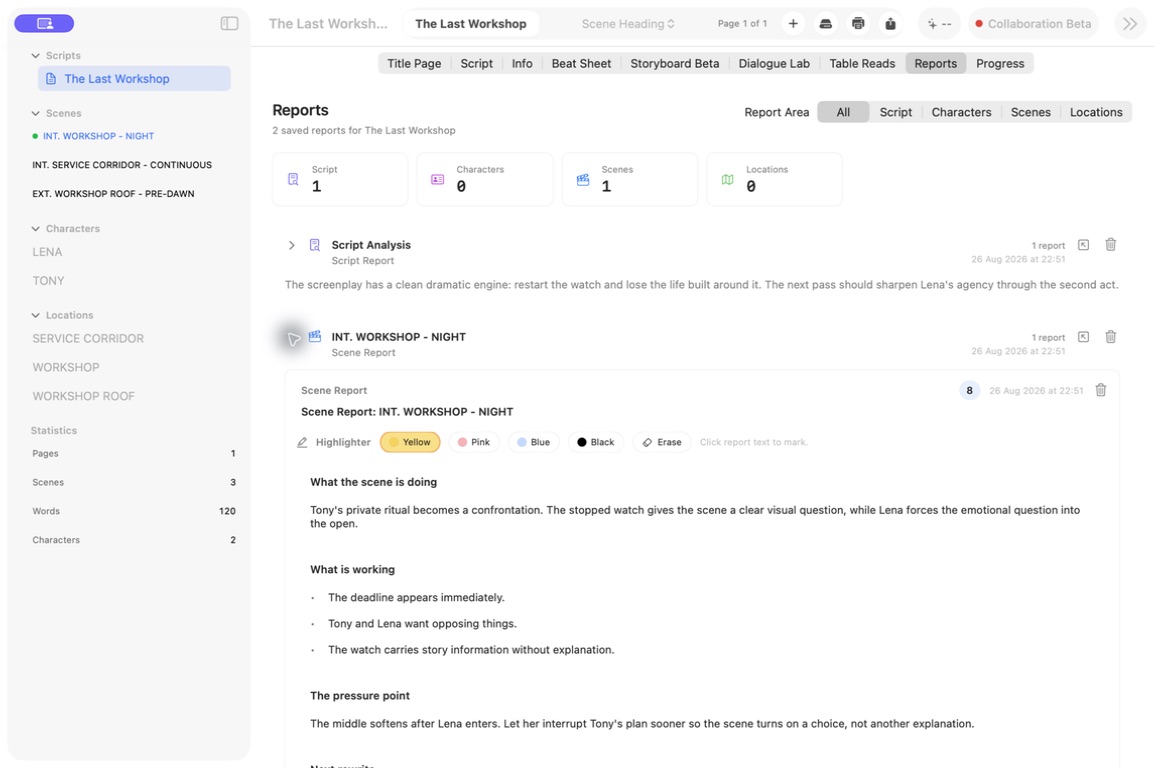
A useful report separates four things: the finding, the evidence in the scene, the likely audience effect and a rewrite test. For example, it might find that a confrontation repeats the same tactic, cite the exchanges where neither character changes approach, explain that the tension plateaus and suggest testing one new tactic before the turning point.
That does not mean accepting the proposed fix. Return to the cited beats, decide whether the diagnosis matches your intention and change one variable. If the scene gains pressure without losing its character, the note was useful. If it pushes the story towards a different film, reject it and keep the evidence that helped you see the scene more clearly.
What an AI script analysis should examine
A report is only useful when its categories match the problem you are trying to solve. Depending on the stage of the draft, ask the analysis to examine:
- Scene purpose: what changes, what new information arrives and why the scene must exist.
- Character objective: what each person wants now, which tactic they use and what stops them getting it.
- Conflict and escalation: whether pressure increases or the same disagreement simply repeats.
- Dialogue and subtext: exposition, repeated information, distinct voices and what remains deliberately unsaid.
- Pacing: late entrances, early exits, stalled sequences and the balance between setup and consequence.
- Structure: turning points, cause and effect, character decisions and whether later events earn their setup.
- Reader clarity: moments where essential information is absent, contradictory or arriving too late.
Do not request all of these on every pass. A long report can create the feeling of progress while leaving the real decision untouched. Choose the category that matches the current rewrite.
Five questions that make scene analysis useful
1. What changes in the scene?
Identify the shift in knowledge, power, commitment, danger or relationship. If the beginning and end are dramatically identical, the scene may be atmosphere, setup or repetition rather than movement.
2. Who wants what right now?
A broad story goal is not enough. Give the scene a playable objective and an active obstacle. “She wants justice” is abstract; “she needs him to sign before the train arrives” creates behaviour.
3. Where does the pressure escalate?
Look for changing tactics, shrinking options and consequences. A scene can contain an argument yet remain static if both characters repeat the same positions.
4. What is said, and what is avoided?
Dialogue gains tension when the spoken line, private objective and social situation pull in different directions. Analysis can flag exposition and repetition, but the writer decides how much ambiguity the scene should keep.
5. Why must this scene be here?
Ask what the audience would lose if the scene disappeared. A necessary scene may advance plot, reveal character, create an emotional turn, set up a payoff or combine several of those functions.
A disciplined AI script analysis workflow
- State the draft stage. Early drafts need structural questions; late drafts may need precision around dialogue, pace or clarity.
- Ask one focused question. “Why does the tension flatten after the midpoint?” produces more useful evidence than “Is this good?”
- Read the report for patterns. Separate repeated observations from one-off suggestions.
- Return to the page. Find the exact lines or beats supporting each claim.
- Choose the diagnosis before the fix. A slow scene might need a stronger objective, a later entrance or a cut, not simply shorter sentences.
- Rewrite one variable. Change the scene’s tactic or turning point, then hear and reread the result.
- Keep your rejected notes. Dismissing a suggestion for a clear artistic reason is part of the process.
Feedback becomes actionable only when you can point to evidence on the page and describe the audience effect you want instead.
Whole-screenplay analysis versus scene analysis
A whole-script analysis is useful when the question spans the complete draft. It can look for structural balance, repeated character patterns, setup and payoff, the distribution of turning points or a relationship that disappears for too long. Its weakness is scale: the broader the request, the easier it is for a report to become general.
Scene analysis is narrower and usually more testable. It can examine the immediate objective, obstacle, tactics, turning point and exit value. If the note says a scene lacks escalation, you can identify the beat where pressure should change and rewrite that variable.
Use the whole screenplay to find the pattern, then use individual scenes to test the repair. ForgePad’s visual beat sheets help keep the larger shape visible while scene reports deal with the local dramatic work.
How to analyse a screenplay scene in ForgePad
- Open the target scene from the scene list.
- Review any existing notes so the report addresses the current question rather than an obsolete draft.
- Generate a scene report from the screenplay workspace.
- Read the sections on scene purpose, conflict, tension, dialogue and rewrite possibilities.
- Save the useful observation as a note beside the scene.
- Use the table read to test dialogue or pacing observations aloud.
- Rewrite in the same editor, then generate fresh feedback only after the scene has materially changed.
AI analysis versus script coverage
Traditional script coverage commonly includes identifying information, a logline, synopsis, comments, ratings and a recommendation. It is usually written by a person for a particular context, such as development, a competition, a producer or the writer’s next rewrite.
AI screenplay analysis is better suited to frequent diagnostic work. It can revisit a scene after a material rewrite, compare a sequence against a focused question and organise observations quickly. Human coverage remains more valuable when you need emotional response, cultural understanding, professional accountability, market context or the judgement of someone who understands the intended audience.
The two do not need to compete. Use AI feedback to resolve obvious or repeated craft questions before paying for someone’s attention. Then give the human reader a cleaner draft and a smaller set of decisions worth discussing. See the guide to receiving and sorting screenplay feedback before beginning that next pass.
How to judge whether AI script feedback is useful
Do not judge a report by its confidence or length. A useful observation should survive four checks:
- It points to evidence. You can identify the line, beat, scene or repeated pattern behind the claim.
- It explains the likely audience effect. The note connects the page choice to confusion, tension, pace, sympathy or expectation.
- It respects the stated intention. It helps the screenplay become a clearer version of itself rather than steering it towards a different genre or story.
- It creates a test. You can make one controlled change and assess whether the reading experience improves.
Reject feedback that invents events, contradicts the screenplay or offers a generic fix with no supporting moment. Keep a note if the proposed solution is wrong but the underlying reader experience reveals a real problem.
Mistakes to avoid
- Generating feedback repeatedly without rewriting between reports.
- Accepting a confident statement without checking the page evidence.
- Applying every suggestion and erasing the script’s distinctive choices.
- Using late-stage line notes to avoid an early-stage structural problem.
- Sharing sensitive material without first reviewing the service’s current privacy terms.
Check privacy before uploading an unpublished screenplay
AI services do not all handle material in the same way. Before uploading an unpublished script, read the current terms for data retention, confidentiality, model training, deletion and access by service providers. Check whether the policy applies to the exact plan or feature you intend to use.
Avoid assuming that a familiar brand name guarantees the settings you want. If the screenplay is subject to an NDA, contains confidential client material or is being shared on behalf of another writer, obtain the necessary permission before using any external analysis service.
AI screenplay analysis FAQ
What is AI screenplay analysis?
AI screenplay analysis is a structured review of a script or scene that looks for evidence about character objectives, conflict, structure, dialogue, pace and clarity. It is most useful as a diagnostic second read, not a final judgement on quality.
Can AI analyse a full screenplay?
An AI tool can review a full screenplay, but a whole-draft report and a scene report answer different questions. Use whole-script analysis for patterns across the story and scene analysis for a specific dramatic problem.
Is AI script analysis accurate?
AI analysis can identify useful patterns, but it can also misunderstand intention, overlook context or offer a confident solution unsupported by the page. Check every claim against the screenplay before accepting it.
Can AI replace professional script coverage?
No. AI analysis can support frequent development work, while professional coverage adds human taste, emotional response, cultural understanding, market context and accountability.
Should I upload an unpublished screenplay to an AI tool?
Review the service’s current privacy, retention, confidentiality and model-training terms before uploading unpublished material. Do not assume every AI service handles scripts in the same way.
Will ForgePad rewrite my screenplay automatically?
ForgePad keeps the writer in control. Its analysis can surface observations and possible rewrite moves, while the writer decides what to accept and makes the changes.
Turn “something is off” into a testable note
Generate a scene report beside the draft, hear the dialogue and make the rewrite yourself in ForgePad.
Analyse a scene in ForgePad ↗