
Start with one clear scene
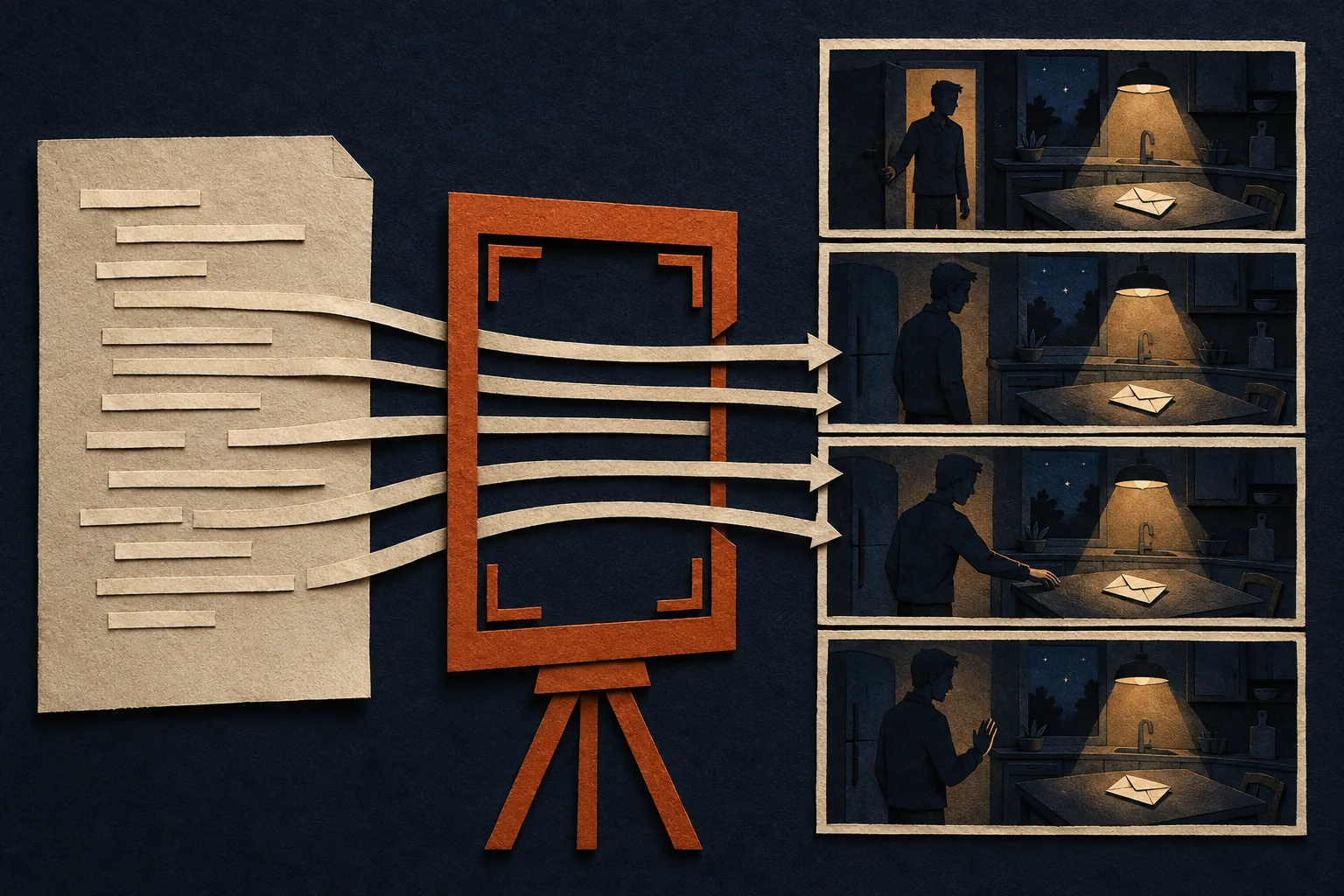
Imagine a short scene: Mara enters her kitchen at night. A sealed letter sits beneath the only light. She approaches, reaches for it, then hears somebody upstairs and stops.
The prose contains setting, action, an important object, a decision and an interruption. Those are enough to build a useful board. The task is not to draw every sentence. It is to decide how the visual order creates the tension.
Write the scene's visual intention
Before drawing, finish this sentence: “The audience should first believe _____, then realise _____.” For the kitchen scene: “The audience should first follow Mara towards the letter, then realise she may not be alone.”
This gives the board a test. If a frame reveals the upstairs threat too early, it damages the intended turn. If the letter is never visually established, Mara's hesitation has no weight.
Separate visible action from internal meaning
A screenplay may tell us that Mara dreads opening the letter. The camera cannot photograph dread as a sentence. It can photograph a slowed step, a held breath, a hand hovering above the envelope or a glance towards the dark hallway.
Make two columns. In the first, list what the script means. In the second, list what the audience can see or hear. Storyboard from the second column, then check that it still carries the first.
- Meaning: she recognises the letter. Visible: her movement stops when she sees it.
- Meaning: she is afraid to open it. Visible: her hand reaches, then stalls.
- Meaning: somebody may be upstairs. Visible: a floorboard creaks and her eyes lift.
Establish the geography you will need later
Sketch a simple overhead plan of the kitchen. Mark the door, table, letter, staircase and light. Decide where Mara enters and which direction she moves. This plan does not appear in the final board, but it prevents objects and eyelines from drifting between frames.
Only establish what the sequence needs. If the staircase matters at the turn, its direction or off-screen position must be understandable before Mara reacts to it.
Build the essential frames
- Entrance: a wide shot places Mara in the doorway and the lit letter across the room.
- Recognition: a medium shot shows her stop as she notices the table.
- Object: an insert makes the unopened letter unmistakable.
- Approach: a side or three-quarter frame tracks her movement while preserving the room.
- Decision: a close frame shows her hand hovering above the envelope.
- Interruption: hold or cut to her reaction as the sound comes from above.
- New question: end on the dark stairwell, or stay on Mara listening, depending on what the audience should know.
These frames create one possible version. Change the order and emphasis to test other versions before choosing.
Storyboard dialogue through listening and behaviour
When a scene contains conversation, resist drawing a new speaking face for every line. Look for changes in power, attention and concealment. A character listening can be more important than the person speaking.
Group lines that can play within one composition. Cut when new information changes how the audience reads the exchange. Use a two-shot when the relationship matters more than either individual reaction. Use an insert only when an object becomes part of the argument.
Check continuity before adding polish
Compare adjacent frames. Mara should move consistently towards the table. The envelope should remain under the lamp. Her reaching hand should not change without reason. The source of the upstairs sound should match her eyeline.
Also check emotional continuity. If she looks terrified before noticing the letter, the scene may be revealing its meaning too early. Physical and dramatic continuity belong to the same sequence.
Make one deliberate alternative
Duplicate the board and change one major choice. Version A may reveal the letter in the opening wide shot. Version B may hide it until Mara sees it. One creates anticipation; the other creates discovery.
Do not create five arbitrary boards. Test the decision that changes the audience's experience most. Compare the versions at thumbnail size and read them without the script.
Let the storyboard improve the screenplay
A board often reveals page problems. Perhaps Mara crosses the kitchen without an obstacle, the letter appears without setup or the sound arrives before tension has built. Repair the screenplay, then update the frames.
ForgePad makes that loop practical because the storyboard sits beside the screenplay. Select a scene, generate frames, refine the sequence and return to the writing when the images expose something unclear.
For the wider process, read how to storyboard a screenplay. For composition choices, use the guide to shot types and camera angles.
Turning scenes into storyboards FAQ
How do you break a screenplay scene into storyboard frames?
Identify the scene's dramatic turn, list the visible actions and important reactions, establish the necessary geography, then create frames for each shot or visual change needed to communicate that movement.
Does every action line need a storyboard frame?
No. Several actions may happen within one shot, while one important action may need multiple frames. Create frames according to visual change and audience information, not sentence count.
How should dialogue appear in a storyboard?
Use short dialogue cues beneath relevant frames when timing or meaning depends on them. Focus the images on listening, behaviour, power shifts and reactions rather than illustrating every spoken line.
Should the storyboard change the screenplay?
It can. If the visual sequence reveals unclear staging, missing setup, repetitive action or a weak turn, revise the screenplay and update the board. The two documents should inform each other.
What scene should I storyboard first?
Choose a scene with a clear visual question, such as an entrance, reveal, confrontation, action sequence or complicated piece of staging. Begin with one scene rather than committing to the whole screenplay.
Translate one scene, not the whole film
Choose a scene in ForgePad, mark its visible turning points and make the first four frames.
Write in ForgePad ↗