Choose the story information before the shot
Shot lists can encourage a menu mentality: one wide, two mediums, three close-ups. A storyboard should begin with the audience's experience instead. What must they understand now? Whose reaction matters? Should they feel close, distant, trapped, powerful or uncertain?
Write the purpose beneath a rough frame before naming the technique. “Reveal that the room is empty” is more useful than “wide shot”. Once the purpose is clear, the shot type becomes a decision rather than decoration.
Use extreme wide and wide shots for geography
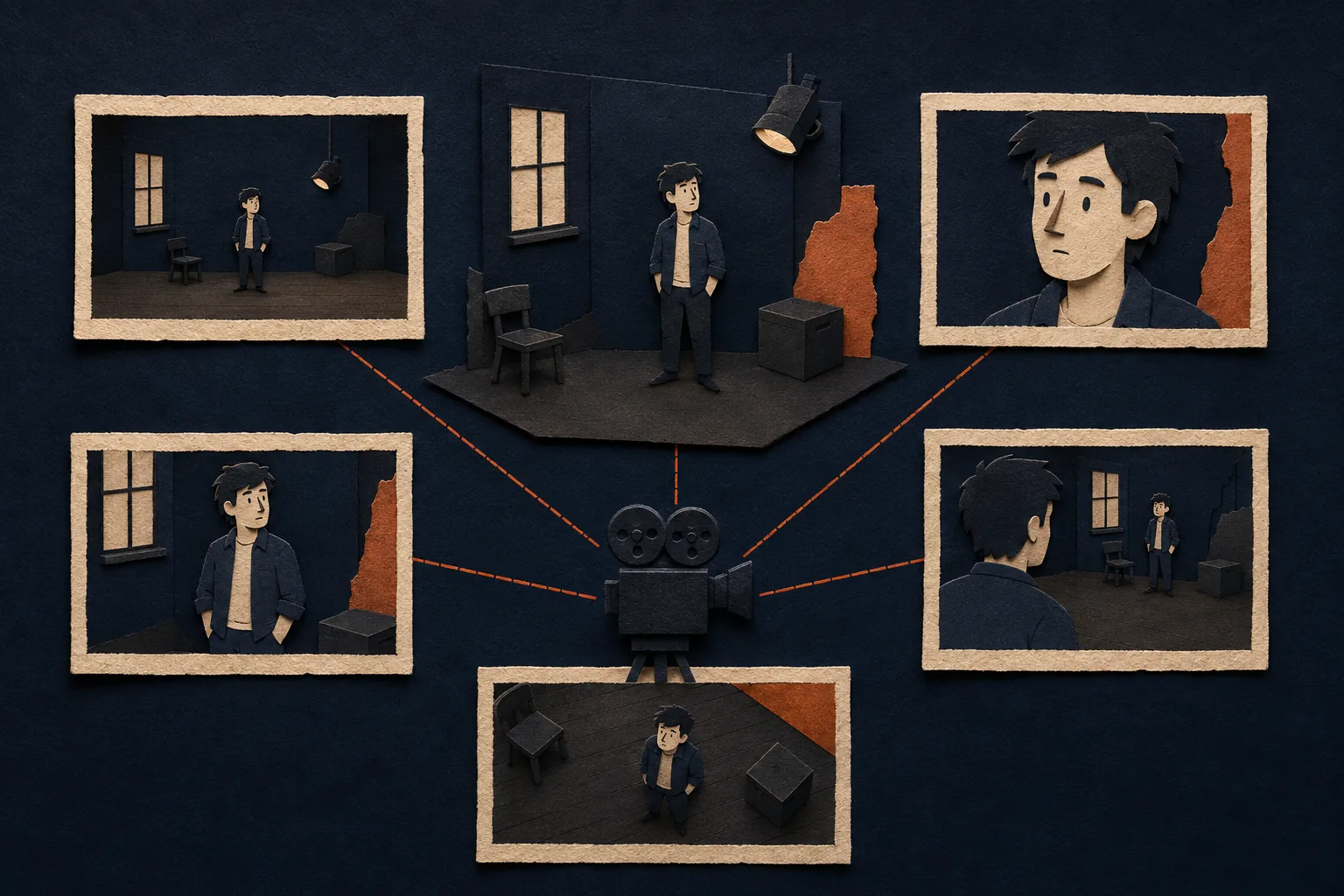
An extreme wide shot makes the environment dominant. It can establish isolation, scale, danger or the distance a character must cross. A wide shot keeps the full body readable and shows how characters relate to the room and to each other.
Use a wide frame when the audience needs to understand an entrance, exit, obstacle or spatial relationship. Return to it when geography has changed. Do not stay wide if the important event is now a tiny expression the audience cannot read.
Use medium shots for behaviour and conversation
A medium shot usually frames a character around the waist or chest. It keeps faces readable while preserving gestures, posture and some environment. This makes it a dependable choice for dialogue and performance.
Two-shots place two characters in the same frame, making distance, alliance and imbalance visible. Over-the-shoulder shots separate the conversation into points of view while retaining the other person as part of the composition.
Use close-ups when the detail changes the scene
A close-up tells the audience that a face or object deserves concentrated attention. It can reveal a decision, withhold context or make a small action feel decisive. An extreme close-up isolates a detail such as an eye, key, trigger or message.
Close-ups lose force when every line receives one. Save them for a change the audience needs to feel or an object they need to remember. In the storyboard, check that the preceding shot gives enough context for the close view to make sense.
Use camera height and angle deliberately
A high angle can reduce a character within the frame, reveal a floor plan or show a pattern invisible at eye level. A low angle can give weight, menace or scale. Eye level often feels direct and observational. A Dutch angle introduces imbalance by tilting the horizon.
These are tendencies, not fixed emotional equations. A low angle does not automatically make somebody powerful. Performance, lens, lighting, movement and context all contribute. Draw the angle because it helps this moment, not because it carries a universal label.
Use point of view to control knowledge
A point-of-view shot shows what a character sees. Pair it with their eyeline so the audience understands whose perception they share. An insert isolates practical information, such as a phone screen or a name on an envelope. A reaction shot shows what that information does to a person.
These three frames often work as a small unit: look, object, reaction. Change the order and the meaning can change. Showing the object before the character notices it creates anticipation. Hiding it until after the reaction creates a question.
Show camera and character movement clearly
Use arrows sparingly. An arrow inside the frame can show a character's path. An arrow at the edge can show a pan or tilt. A second frame can show the end of a dolly, crane or handheld move. Add a short note if the drawing could be misread.
Movement should reveal, follow, connect or transform something. “Camera moves closer as she decides to open the letter” gives the move a dramatic reason. “Push in” alone only names the mechanism.
Create contrast without making the sequence random
A sequence gains rhythm from changes in distance, angle, duration and movement. It also needs visual logic. Sudden changes are strongest when they mark a real shift in the scene.
- Move closer as pressure becomes personal.
- Cut wider when new geography changes the problem.
- Hold the same composition when repetition is the point.
- Break a stable pattern when the scene turns.
- Use a reaction instead of illustrating every spoken line.
Review the storyboard as thumbnails. If the frames look almost identical, the scene may need more visual progression. If every frame is radically different, the audience may struggle to understand the space.
Separate the storyboard from the coverage plan
A storyboard describes the intended visual sequence. Coverage describes the material captured so an editor has choices. They overlap, but they are not identical. A production may film a master shot and additional angles even when the storyboard presents a precise cut.
Mark essential storyboard frames separately from optional coverage. This protects the shots that carry the scene while leaving room for performance and editorial discovery.
When you are ready to build a sequence, follow the full guide to storyboarding a screenplay.
Storyboard shots and angles FAQ
What are the main storyboard shot types?
Common shot types include extreme wide, wide, full, medium, close-up, extreme close-up, two-shot, over-the-shoulder, point-of-view and insert shots. Choose among them according to the information and emotional distance the scene needs.
What camera angles should be shown in a storyboard?
Show any angle that materially affects the shot, including eye level, high angle, low angle, overhead or a tilted horizon. Make the camera position clear enough that the production team can understand the intended composition.
How do you show camera movement on a storyboard?
Use simple directional arrows and, when necessary, separate start and end frames. Add a short note naming the movement and explaining what it reveals or follows.
What is the difference between a shot list and a storyboard?
A shot list records the planned shots in text. A storyboard shows their composition and sequence visually. Many productions use both because each communicates different practical information.
Should dialogue scenes use close-ups for every line?
No. Use close-ups when a reaction, decision or detail deserves emphasis. Two-shots, medium shots and held compositions can preserve relationships and allow the performance to breathe.
Give every frame a purpose
Build a short sequence in ForgePad and ask what each change of size or angle adds to the scene.
Write in ForgePad ↗